New York civic education

New York Seal of Civic Readiness: six points, three caps, one clear guide.

Download the free two-page reference, then use this planning hub to map civic knowledge to authentic participation. It gives teachers, counselors, and local committees a clear starting point without pretending that every NYSED document uses identical language.

Reviewed against NYSED guidance on August 15, 2026.

Current NYSED framework

6 total points
2+ Civic Knowledge
2+ Civic Participation
Plus two additional points from either column and all applicable diploma requirements.
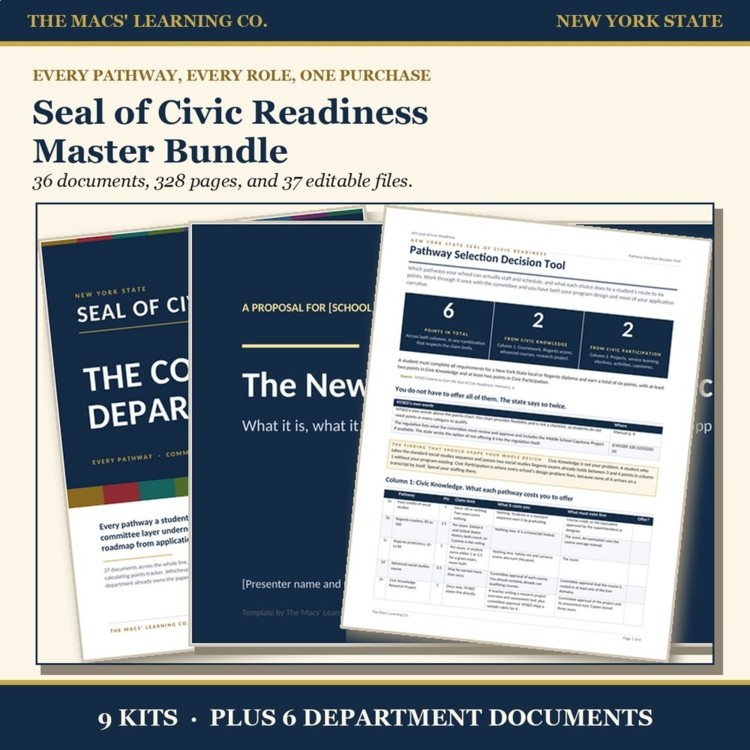
NYS Seal of Civic Readiness Master Bundle showing all pathway, committee, planning, and communication documents Master Bundle implementation roadmap showing eight phases from the first school meeting through graduation reporting

New complete Seal system on TPT

Launch the Seal without building the operating system from scratch.

The pathway documents are only half the work. A school still has to choose what it can staff, build the committee, set deadlines, record decisions, brief leadership, communicate with families, track evidence, and carry the first cohort through June.

  • 36 documents, 328 pages, and 37 editable files
  • Nine complete kits covering the point menu, tracker, projects, Capstones, hours pathways, committee operations, and policy decisions
  • Six department documents available only in the bundle
  • Eight-phase implementation roadmap and pathway selection decision tool
  • Editable board presentation, one-page leave-behind, deadline calendar, and family and student communication set
  • Print-ready PDF, editable Word, Excel tracker, and editable PowerPoint formats

The live TPT listing provides the current bundle price, licensing, and multi-user terms.

New NYSED conflicts and decisions guide on TPT

When the state documents disagree, record the action that holds either way.

This independent Safe Harbor Guide identifies eleven places where current NYSED Seal materials conflict, create a paperwork trap, or leave a local decision blank. It does not claim to resolve what only NYSED can resolve. It asks which action remains defensible under every published reading.

  • 20 TPT-listed pages in print-ready PDF and editable Word
  • Six direct conflicts with a stricter action that holds under either reading
  • Two paperwork traps where the written rule and the sample form do not align
  • Three areas with no state safe harbor, clearly assigned to local committee decision
  • Source quotations, citations, recommended action, and rationale for every item
  • A decision box for the district choice, approver, and date

The guide is not a ruling or NYSED interpretation. Confirm application status, deadlines, and unresolved requirements directly with NYSED and preserve the local committee record.
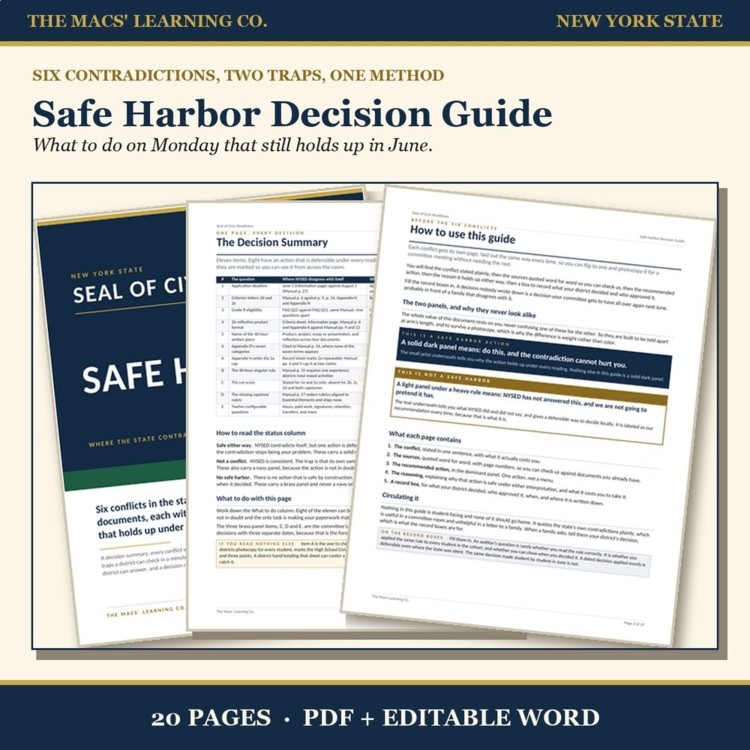
Seal of Civic Readiness Safe Harbor Guide cover showing eleven NYSED conflicts and local decisions Safe Harbor Guide preview showing cited conflict, recommended action, and district decision record fields

Start with the official structure

Six points, balanced across knowledge and participation.

NYSED currently requires six total points, with at least two from Civic Knowledge and at least two from Civic Participation. The remaining two may come from either column. The point chart is flexible, not a requirement to complete every listed component.

Students must also complete the requirements for a New York State local or Regents diploma. Approved schools and their local Seal of Civic Readiness Committees determine processes, review evidence, and apply the current state guidance.

Column 1

Civic Knowledge

  • Social studies coursework
  • Regents exam performance
  • Advanced social studies courses
  • Research projects

Column 2

Civic Participation

  • High school civics projects
  • Service-learning with reflection
  • Eligible civic coursework
  • Work-based or extracurricular learning
  • Capstone pathways

A department planning sequence

Turn the state framework into work students can actually complete.

Local committees control the final approval process. This sequence helps teachers organize instruction and evidence before applying local rubrics.

  1. 01

    Map the pathways

    Identify which approved knowledge and participation components your school will support.

  2. 02

    Define the civic issue

    Help students choose a question rooted in their school, community, or public life.

  3. 03

    Teach evidence

    Build research, source evaluation, media literacy, and argument before asking for action.

  4. 04

    Plan informed action

    Connect the evidence to a realistic audience, decision-maker, service, or public product.

  5. 05

    Document the process

    Keep artifacts, logs, drafts, feedback, and presentation evidence organized from the start.

  6. 06

    Reflect and present

    Ask students to explain what changed, what did not, and what responsible civic action requires next.

New editable tracker on TPT

One roster. Automatic totals. Two cap warnings.

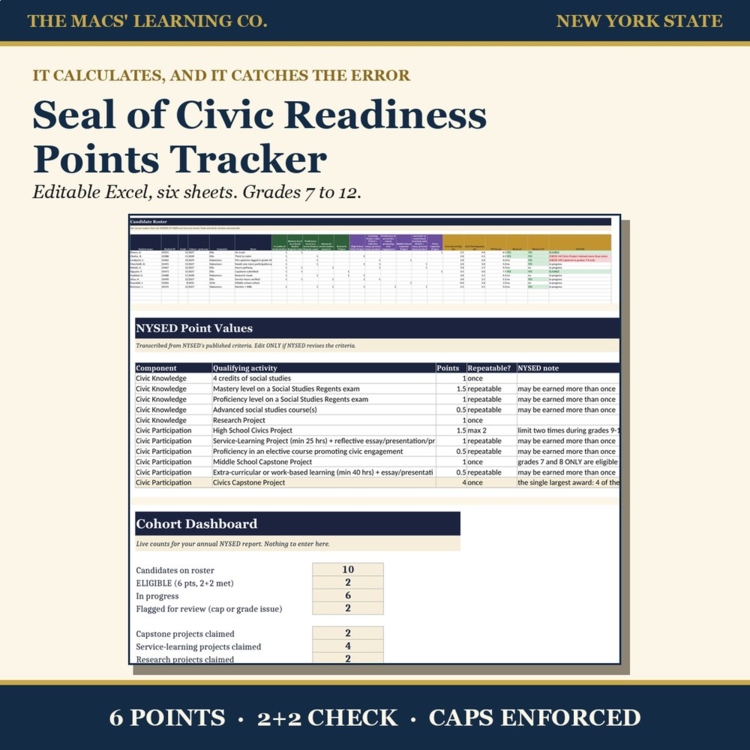
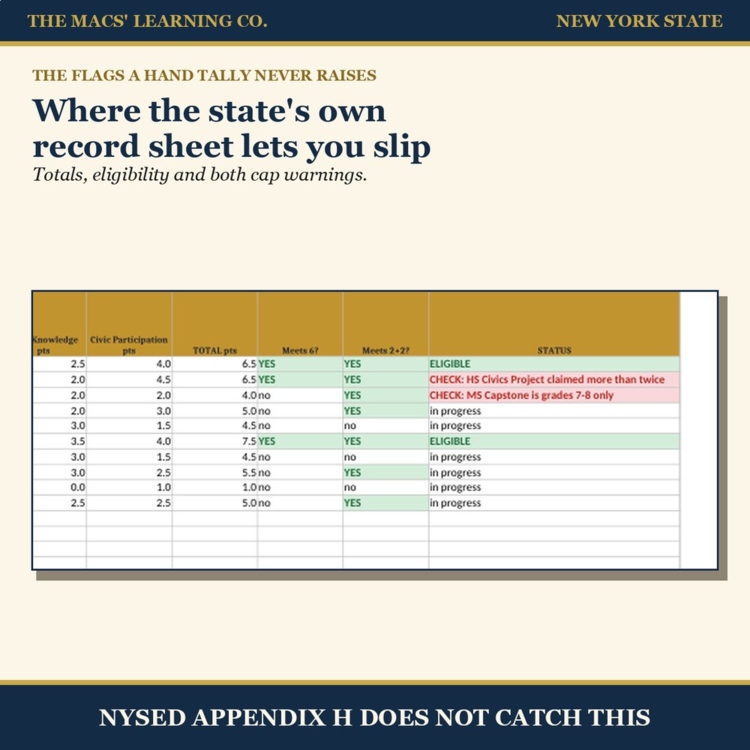
The free guide explains the point menu. The six-sheet Excel tracker runs the cohort: enter what each student earned and it calculates Civic Knowledge, Civic Participation, the six-point total, and the 2+2 minimum.

  • Roster for up to 200 students
  • Evidence log for up to 400 entries
  • Committee record for up to 100 meetings
  • Live dashboard for annual reporting
  • Warnings for a third High School Civics Project claim and a Middle School Capstone outside grades 7-8

One blank .xlsx workbook. No macros, account, login, upload, or network calls. Current price and license options are shown on TPT.

Seal of Civic Readiness Excel points tracker showing the roster, point-values sheet, and cohort dashboard Seal tracker status warnings for a third High School Civics Project claim and an ineligible Middle School Capstone
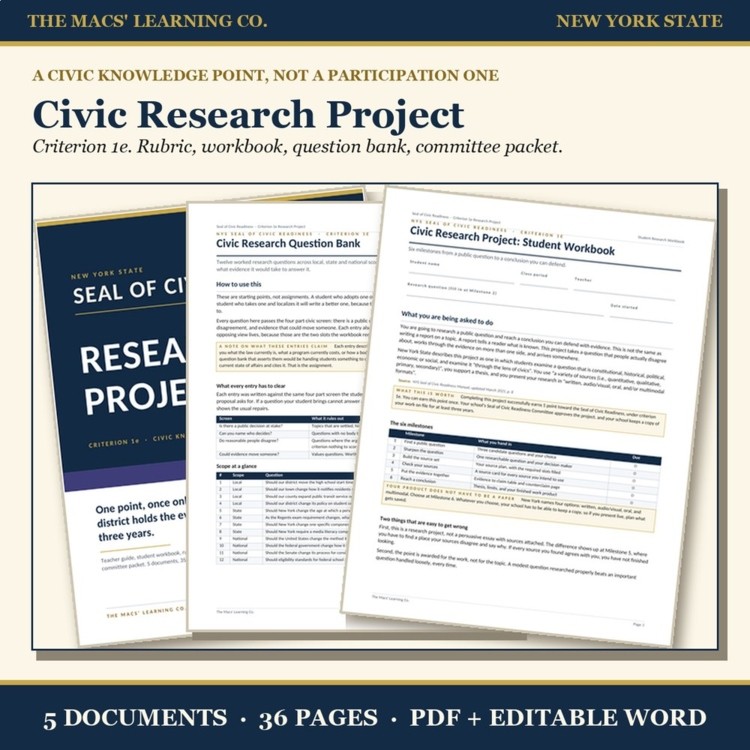
Civic Research Project 1e kit showing the one-point once-only rule and three-year evidence-retention requirement Civic Research Project preview showing the Appendix I rubric and worked local, state, and national research questions

New Civic Knowledge Research Project 1e kit on TPT

The one-point research pathway needs a three-year evidence trail.

Criterion 1e is worth one Civic Knowledge point and can be earned once. It is the project-based knowledge route, and NYSED directs schools to retain completed work for at least three years in case of audit.

  • Five files and 36 TPT-listed pages
  • Teacher implementation guide and six-milestone student workbook
  • Appendix I rubric with five criteria and four performance levels
  • Twelve worked research questions across local, state, and national scope
  • Proposal, approval, completed-work, retention, and custodian forms
  • Print-ready PDF and editable Word versions of every file

The kit preserves the state's once-only rule and the distinction between course-level assignment approval and per-student work review. Local committees should verify their current approval procedure with NYSED guidance.
New grades 9-12 Project 2a kit on TPT

Make the 1.5-point pathway and its two-claim cap visible from day one.

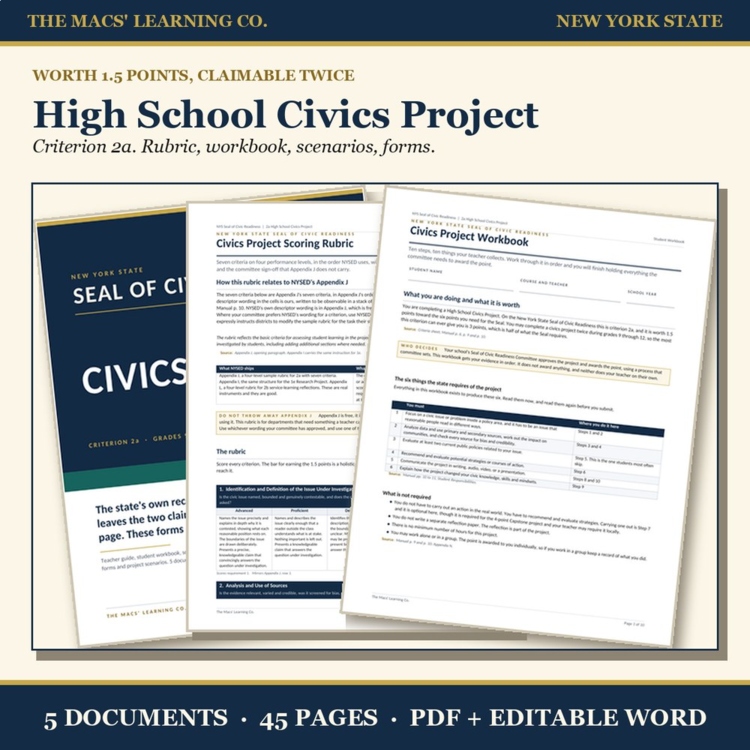
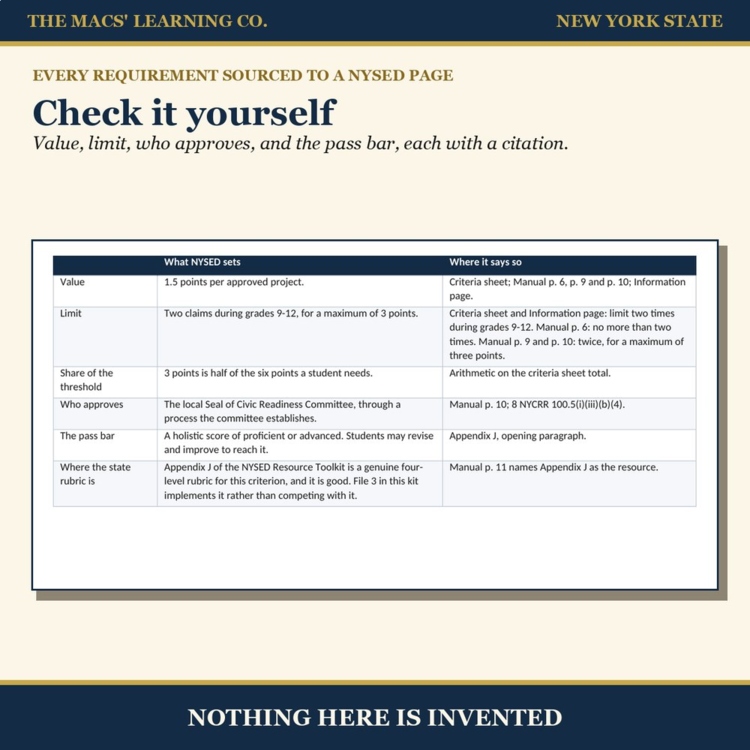
The High School Civics Project is worth 1.5 points and may be claimed twice across grades 9-12. This kit maps the six state requirements into ten student steps and keeps the claim cap, evidence trail, revision process, and local committee decision in view.

  • Five files and 45 pages
  • 10-page implementation guide and 10-page student workbook
  • Appendix J rubric with seven criteria, four performance levels, and committee sign-off
  • Eight ready-to-run scenarios at school, local, state, and national or global scales
  • Evidence and verification forms, Form F7 correction slip, claim card, and cohort cap tracker
  • Print-ready PDF and editable Word versions of every file

Two approved claims can contribute three of the six points a student needs. Current requirements, price, and license options should be verified on NYSED and TPT.

High School Civics Project 2a kit showing the rubric, student workbook, and teacher materials for grades 9 through 12 High School Civics Project claim check showing the 1.5-point value, two-claim limit, committee approval, and proficiency pass bar
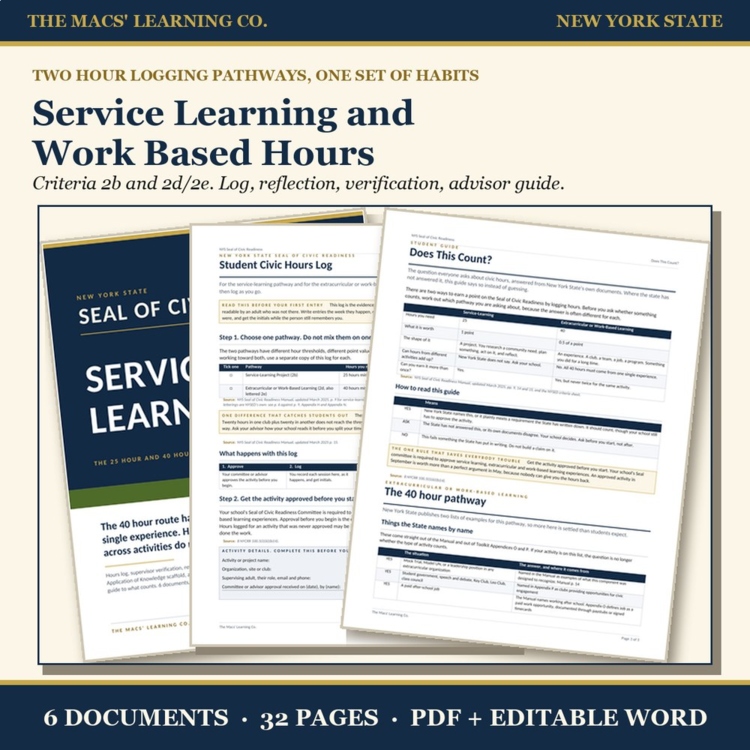
Service Learning and Work Based Hours kit showing the student log, eligibility guide, and advisor materials Rules page explaining that the 40-hour pathway requires one single experience and does not combine hours from different activities

New 25-hour and 40-hour pathways kit on TPT

Twenty hours plus twenty hours is not forty for the work-based claim.

The service-learning pathway requires 25 hours and is worth one point. The extracurricular or work-based pathway requires 40 hours and is worth half a point. For that 40-hour route, NYSED requires one single experience. This kit puts the difference on the log before students begin.

  • Six files and 32 pages
  • Advisor guide to the hours pathways
  • Student civic hours log and supervisor verification form
  • Does This Count guide with YES, ASK, and NO categories
  • Service-learning reflection scaffolds and format rubric
  • Application of Knowledge scaffold for the 40-hour route
  • Print-ready PDF and editable Word versions of every file

The kit treats unresolved or inconsistent state language as a local committee decision, labels recommendations, and cites the relevant NYSED pages. Current requirements and local approval procedures should always be verified.
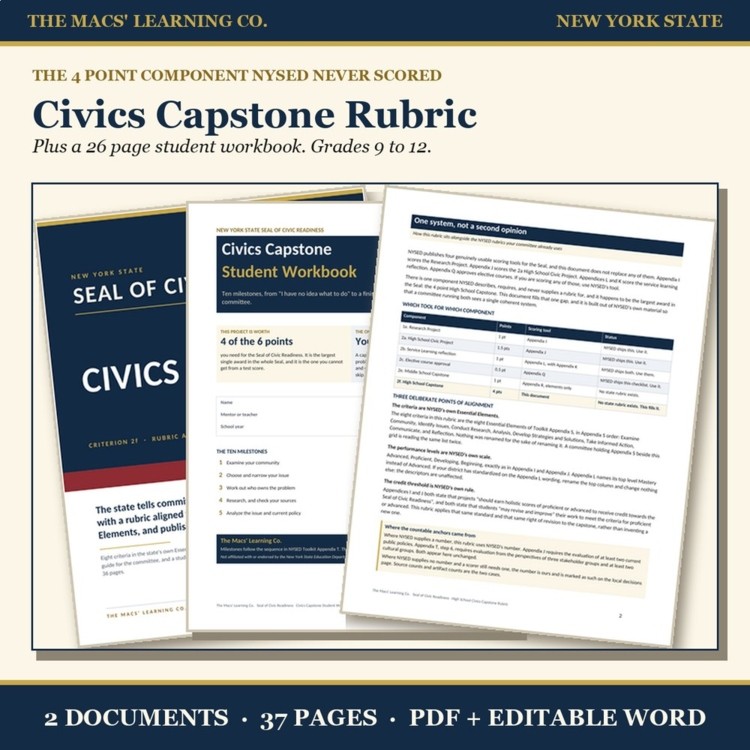
Grades 9 through 12 Civics Capstone kit showing the rubric and student workbook for the four-point Seal pathway High School Capstone scoring preview showing eight Appendix S-aligned criteria and four performance levels

New grades 9-12 Capstone 2f kit on TPT

Four of the six points depend on a rubric the state never published.

NYSED publishes eight Capstone Essential Elements in Appendix S and directs local committees to use aligned rubrics. It does not publish a grades 9-12 Capstone rubric. This independent kit builds that missing scoring system and makes every local decision visible.

  • Two documents and 37 TPT-listed pages, each in print-ready PDF and editable Word
  • Eight criteria in Appendix S order and four performance levels
  • One-page committee score sheet with evidence columns, decision boxes, and signatures
  • Two complete exemplars scored and annotated criterion by criterion
  • 26-page student workbook with ten milestones, mentor checkpoints, source log, and dated action record
  • Crosswalk from every criterion to its Essential Element and nearest state rubric row

The included 24-of-32 threshold, no-Beginning gate, and required-element rule are local scoring decisions, not NYSED rules. The kit labels them accordingly and preserves the committee's authority to revise them.

New Seal committee admin kit on TPT

Run the committee year, not just the student project.

NYSED names a student application and student, mentor, and counselor checklists, then does not publish them. This independent operations kit supplies those forms and the institutional layer around them: membership, calendar, review, determination, reconsideration, audit trail, and annual reporting.

  • Five documents and 36 TPT-listed pages, each in print-ready PDF and editable Word
  • 14-page committee operations manual with a month-by-month year
  • Five-page student application packet written for students to read
  • Eight pages of student review, determination, incomplete-claim, and reconsideration forms
  • Counselor tracking guide and per-student checklist
  • Ten-minute administrator briefing, agenda, minutes, annual reporting worksheet, and source ledger

Where NYSED does not prescribe a date, quorum, appeal route, retention period, or local form, the kit labels the gap and gives the committee a blank to record its own decision.
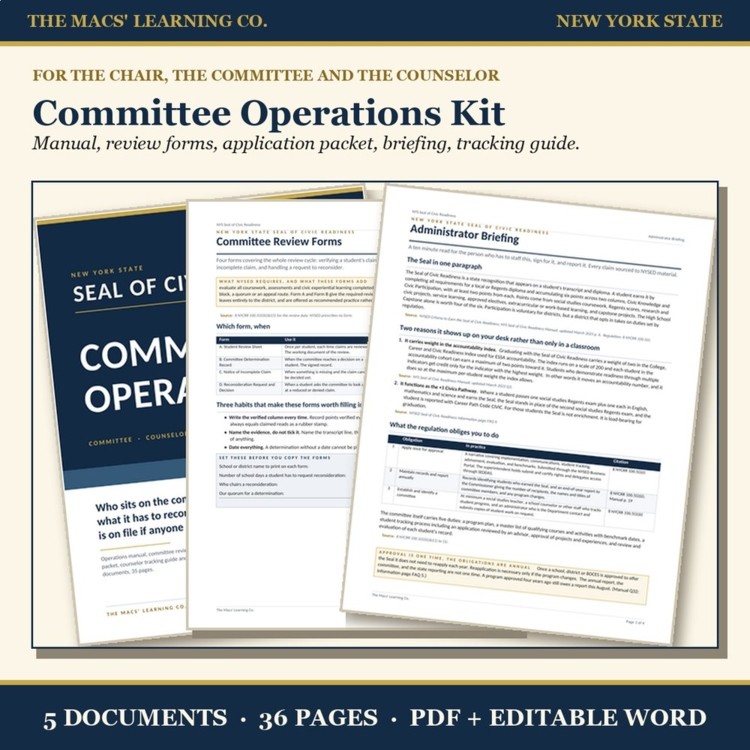
Seal of Civic Readiness committee operations kit showing the manual, review forms, student application, counselor guide, and administrator briefing Seal committee admin kit preview showing the application packet, review forms, calendar, and local decision records
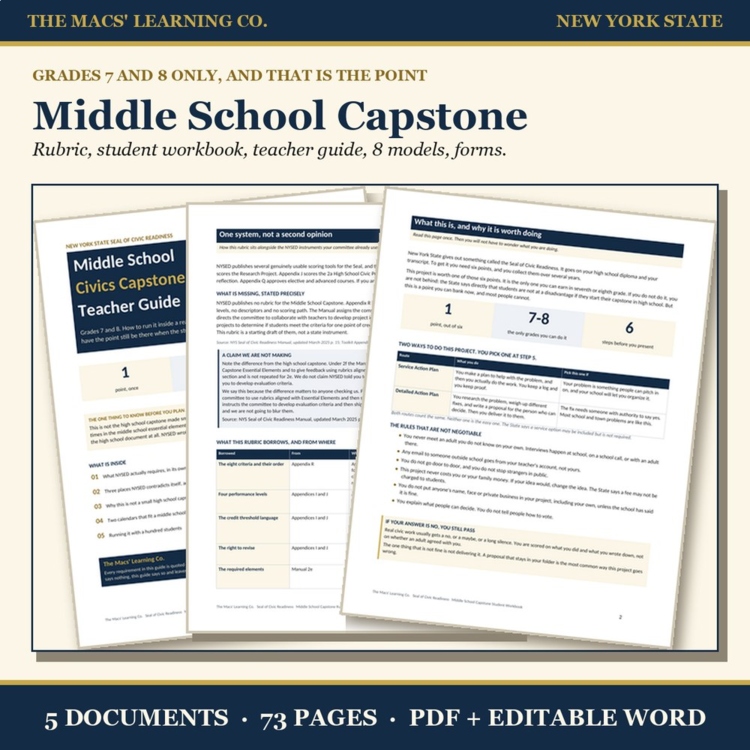
Middle School Capstone kit showing the teacher guide and interior planning pages for grades 7 and 8 Worked middle-school civic action model with a guiding question, research, action, evidence, presentation, and reflection

New grades 7-8 Capstone kit on TPT

A middle-school pathway, not a high-school project made smaller.

The one-point Middle School Capstone must be completed in grades 7 or 8. This kit is built to Appendix R and the teacher scaffolding NYSED assumes for middle-school students.

  • Five files and 73 pages
  • 16-page teacher guide and 16-page eight-step student workbook
  • Eight-criterion, four-level rubric with required-element gates
  • Eight worked civic-action models grounded in reachable local issues
  • Seven committee, evidence, transfer, and annual hand-off forms
  • Print-ready PDF and editable Word versions of every file

The annual transmittal and transfer protocol are designed to help the locally awarded point survive until diploma-year reporting. Current price and license options are shown on TPT.

Quick answers for New York schools

NYS Seal of Civic Readiness FAQ

Use these answers to orient a department or student, then verify local procedures with your school's Seal committee and the current NYSED guidance.

How many points are required for the New York State Seal of Civic Readiness?

Students must earn six total points, including at least two points in Civic Knowledge and at least two points in Civic Participation. They must also meet the requirements for a New York State local or Regents diploma.

Does every student complete the same Seal of Civic Readiness checklist?

No. NYSED uses a flexible point menu. Students may combine eligible knowledge and participation components, while approved schools and local Seal committees set their review and evidence procedures.

Where should a school verify current Seal of Civic Readiness rules?

Start with the current NYSED Seal information page, manual, and resource toolkit. Local committees should confirm which pathways, documentation, rubrics, and approval steps their school will use.

Build the classroom pathway

Connect the Seal to AP Government and Participation in Government.

The free guide clarifies the point system. These classroom-ready government resources help students practice source analysis, constitutional reasoning, civic research, and informed participation.

Free on TPT now

Put the six-point menu and three caps in one clear handout.

The Master Bundle now carries the complete schoolwide system. The Safe Harbor Guide documents unresolved policy decisions. The free guide explains the point menu. The tracker runs a cohort. The project, hours, Capstone, and committee kits supply the classroom and operational pathways.